 8.0 Inch TFT LCD Display With LVDS Interface From China Manufacturer Now Available!
 English
 簡體中文
簡體中文 日本語
日本語 Deutsch
 ???
??? Русский язык
 Espa?ol
 Fran?ais




STM32 Smart Display Solution
 August 08, 2025
 524
524


HOTHMI's recent R&D achievements, technological breakthroughs and developments
August 08, 2025
524
From smart home touchscreens, industrial equipment HMIs (human-machine interfaces), drone image transmission displays, to wearable health dashboards, who silently orchestrates every pixel behind these dazzling displays? The STM32, a 32-bit microcontroller family from STMicroelectronics, with its robust ecosystem, flexible architecture, and exceptional performance, has become the "engine" behind these displays. The STM32 brings more than just lighting to the screen; it also comprehensively optimizes performance, power consumption, cost, and development efficiency.
Rich communication interfaces:Full support for parallel and serial
Parallel interface (FSMC/FMC): This is key to driving RGB interface TFT LCDs. The FSMC (Flexible Static Memory Controller)/FMC (Flexible Memory Controller) operates LCD display memory like internal memory, enabling high-speed data transfer without frequent CPU intervention, which is the foundation for a smooth UI.
Serial interface (SPI/I2C): For small, low-resolution screens (such as OLEDs and SSD1306), the SPI interface, with its simplicity and low pin count, is the preferred choice for cost-sensitive projects. I2C, on the other hand, is commonly used to drive character LCDs or configure touchscreen chips.
Powerful graphics processing accelerator:GPU is gone, DMA2D comes to the rescue
Image Fill: Quickly clear the screen or draw a solid color block.
Image Copy: Create layer overlays and window movements (such as a sliding effect).
Image Format Conversion: Convert formats like ARGB8888 to RGB565 in real time during transmission, saving bandwidth and storage space.
In some high-performance series (such as STM32H7), the Chrom-ART accelerator provides more powerful graphics capabilities.
Integrated hardware graphics peripherals:LTDC
LTDC (LCD-TFT Display Controller): This is the core hardware used by the STM32 to drive high-performance RGB interface displays. It automatically reads data from the video memory and generates RGB signals and horizontal and vertical synchronization signals that meet timing requirements. This is fully implemented in hardware, with zero CPU overhead.
High-performance core and large memory: guarantee a smooth experience
Cortex-M core performance:From M0+ to M7, STM32 offers a wide range of performance options. The high clock speed and DSP instruction set of M4/M7 can easily handle complex algorithms and GUI logic.
Hardware acceleration, ultimate smoothness: DMA2D and LTDC bring the advantage of "hardware acceleration". Compared with pure software screen refresh solutions, the frame rate is greatly improved and the CPU usage is extremely low.
Support for high resolution: With FMC/LTDC, it is easy to drive displays with 800x480 or even higher resolutions.
Intelligent power management:
Supports multiple low-power modes. When displaying static content, the CPU can enter sleep mode and the display is maintained by hardware peripherals.
Extreme cost-effectiveness
“All-in-One”Solution: A single chip integrates display control, user logic, communication interfaces (such as UART, CAN, Ethernet), and control functions, reducing external components and overall BOM cost.
Powerful middleware support:
TouchGFX: ST's own high-performance GUI framework fully utilizes the hardware acceleration features of STM32 to create very cool UIs, and some models are free of charge.
STM32CubeProg: A convenient programming tool.
Industrial HMIs: Reliability, real-time performance, and support for complex interfaces.
Smart home control panels: Smooth touch experience, networking capabilities (with Ethernet or Wi-Fi modules), and a beautiful UI.
Medical device dashboards: Stability and low error.
Consumer electronics (such as fitness bands and toys): Low power consumption and cost control.
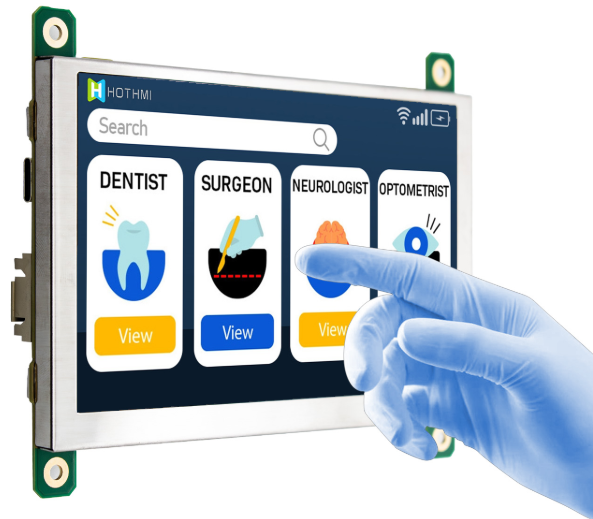
STM32F767 high-performance ARM Cortex-M7 core microcontroller
High-definition display experience: Equipped with a 5.0-inch TFT LCD with a resolution of 800×480 (WVGA), it displays crisp, detailed content for outstanding visual effects.
Precise touch experience: Equipped with the GT911 capacitive touch chip (CTP), it supports multi-touch and delivers sensitive and accurate touch response, providing users with a smooth and natural modern human-computer interaction experience.
Highly integrated design: Touch functionality is seamlessly integrated with the display driver. The STM32 directly processes touch signals, simplifying external circuit design and improving system reliability.
Simplified communication interface: Utilizes the USART (Universal Asynchronous Receiver/Transmitter) interface for host communication, featuring a simple protocol and easy connection, significantly reducing the development complexity and resource usage of the host control system.



China LCD TFT Display Manufacturer, Global Supplier